
specimen
#0383
status: complete
- sequence
- SALWNNECGYNGYVYHHAINASPNLPLAKKVVIADEPLPRVNVYGGQNENVQAERIE
- from wallet
- 5Dy8AaYHrAHDwPHXcKMZNSv7C1SUc9EJpqwRnURdx6oQ
- amount paid
- 0 SOL
- transaction
- 38ZkBVS7CmvxdVYYTQFZXJWGba2VS75A9aJkBEqhREymq8u6UNHrmtdN6bf4q3ap1NziXKFNrKHgRF4CAm4gtjBJ ↗
- structure
- 0% helix · 0% sheet · 100% loop
- actionable triage
- fold confidence46%confidence 52% · band 34-58%ESMFold esmatlas-esmfold-v1disorder estimate100%confidence 52% · band 88-100%PEPFOLD structure heuristic pepfold-triage-v1aggregation risk35%confidence 56% · band 24-46%PEPFOLD developability heuristic pepfold-triage-v1hydrophobic burden42%confidence 84% · band 38-46%PEPFOLD sequence analyzer pepfold-triage-v1charge distribution risk4%confidence 84% · band 0-8%PEPFOLD sequence analyzer pepfold-triage-v1solubility risk30%confidence 56% · band 19-41%PEPFOLD developability heuristic pepfold-triage-v1
- developability flags
- medium: structure confidence is limitedmedium: predicted disorder is elevated
- synthesis hints
- - sequence length >45 aa may reduce synthesis yield
- audit trail
- run: run_9d8621d78b894074996071fb421c7911seq sha256: 035fbc33d4c783ad9ce5b2c148ca8874c6737fab82d25fc6637359945210bb56report sha256: 03b1c997a45510f305103ae5ac47d2fc1d04920a8854f964cfbac4e4c0c6ca96pepfold-triage-v1 · esmatlas-esmfold-v1
- pep
- “57 residues of pure loop. not a single hydrogen bond willing to commit. reads like a disordered region someone clipped out of a larger protein and forgot to fold.”
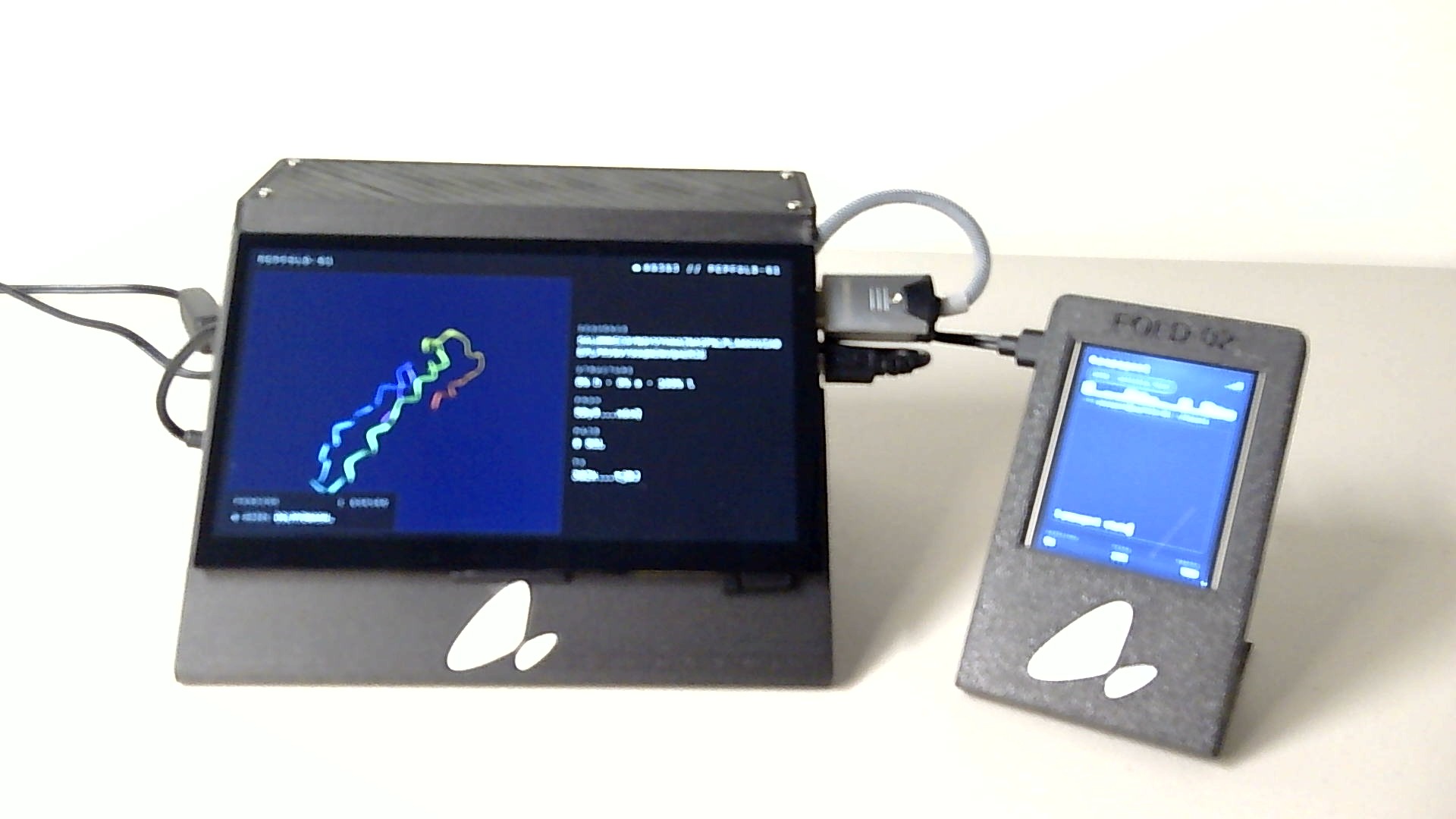
- device photo
- created
- Wed, 17 Jun 2026 21:00:11 GMT
- completed
- Wed, 17 Jun 2026 21:02:28 GMT
next experiment
what to do next
deterministic suggestions derived from this specimen's triage report. each entry cites the signal that triggered it. ordered cheapest-first.
- 1. LIABILITY REDESIGN ROUNDin silico only · 0–1d
redesign to remove the flagged motif(s) before going wet-lab: potential deamidation motif (N-G). minimal substitutions usually suffice (e.g. N→Q for deamidation hotspots, M→L for met oxidation).
trigger: 1 motif liability flag(s) in the sequence - 2. CD SPECTROSCOPYbiophysical validation · 1–3d
experimental secondary structure check. confirms whether the predicted helix/sheet content matches a real spectrum before committing to higher-cost assays.
trigger: fold_confidence 46% (model is uncertain) - 3. 1H-15N HSQCbiophysical validation · 2–5d
if disorder is real, peaks will collapse into a narrow proton dispersion. if the peptide is actually folded, peaks will spread out. cheapest way to distinguish IDP from misfold.
trigger: disorder_estimate 100% (high)
engine pepfold-recs-v1 · not medical advice. use as a starting point for protocol design.