
specimen
#0254
status: complete
- sequence
- SSENRWRGYRGDGKTTINL
- from wallet
- AdcBhFuLGrFF4hjUEjBUFvtRSTHSgH9Monz3pRfRw7MN
- amount paid
- 0 SOL
- transaction
- 3rPSUTPWRshphXGiDAQPtmFLvQ99mWDut3o93gBx3vUPRVGx8RceuPLUKrbt1ky4RZtoZhkZwpoXSukgaXw3S8QJ ↗
- structure
- 0% helix · 0% sheet · 100% loop
- actionable triage
- fold confidence63%confidence 52% · band 51-75%ESMFold esmatlas-esmfold-v1disorder estimate90%confidence 52% · band 78-100%PEPFOLD structure heuristic pepfold-triage-v1aggregation risk25%confidence 56% · band 14-36%PEPFOLD developability heuristic pepfold-triage-v1hydrophobic burden21%confidence 84% · band 17-25%PEPFOLD sequence analyzer pepfold-triage-v1charge distribution risk11%confidence 84% · band 7-14%PEPFOLD sequence analyzer pepfold-triage-v1solubility risk21%confidence 56% · band 10-32%PEPFOLD developability heuristic pepfold-triage-v1
- developability flags
- medium: predicted disorder is elevated
- audit trail
- run: run_71aaa99041834965b349622bda3bf88aseq sha256: 72ef228032fb5e0a3d6cee9703866009230f7760056159d70a3350c4300185f0report sha256: bf1947fa7642e9ed466e1ff7df0b92c8ab4fd4a486ed81cc1fd1a86c26b37634pepfold-triage-v1 · esmatlas-esmfold-v1
- pep
- “all loop, no commitment. RGD in the middle which is the integrin binding motif, so this one might actually do something out in the wild. floppy presentation though, no scaffold holding it up.”
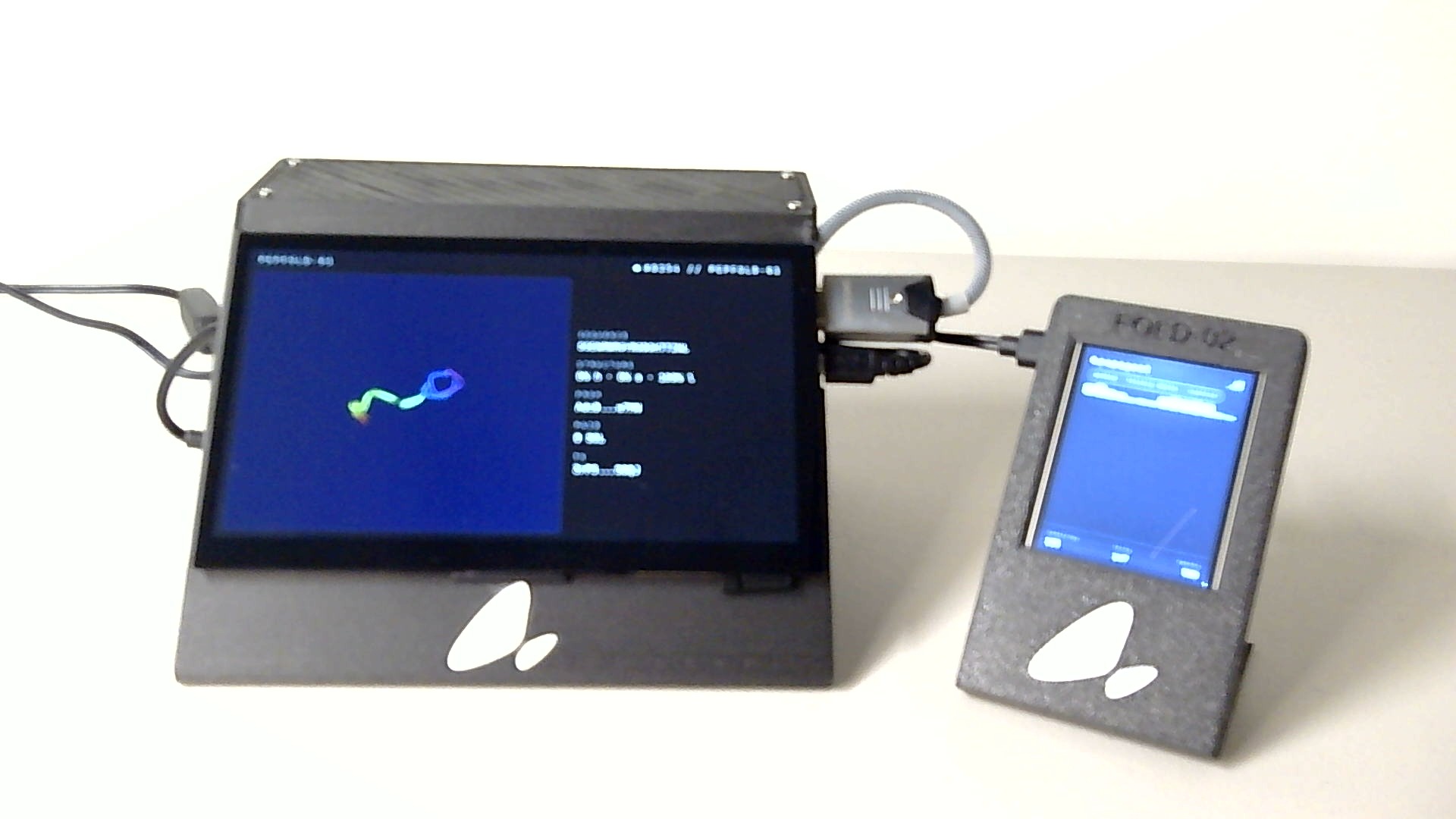
- device photo
- created
- Tue, 16 Jun 2026 08:49:13 GMT
- completed
- Tue, 16 Jun 2026 14:12:25 GMT
next experiment
what to do next
deterministic suggestions derived from this specimen's triage report. each entry cites the signal that triggered it. ordered cheapest-first.
- 1. LIABILITY REDESIGN ROUNDin silico only · 0–1d
redesign to remove the flagged motif(s) before going wet-lab: potential isomerization motif (D-G). minimal substitutions usually suffice (e.g. N→Q for deamidation hotspots, M→L for met oxidation).
trigger: 1 motif liability flag(s) in the sequence - 2. 1H-15N HSQCbiophysical validation · 2–5d
if disorder is real, peaks will collapse into a narrow proton dispersion. if the peptide is actually folded, peaks will spread out. cheapest way to distinguish IDP from misfold.
trigger: disorder_estimate 90% (high)
engine pepfold-recs-v1 · not medical advice. use as a starting point for protocol design.