
specimen
#0188
status: complete
- sequence
- NVVPHRNGQDSEGRKGTVANPAAIAIRIREEFGR
- from wallet
- BzBomhaACTVa1RLCkQE7kyLgfLGKdUysrREmbeGzfndA
- amount paid
- 0 SOL
- transaction
- 28GY6yVaxF46TLj5z92x1MxqyecqEW1BAWykzFBER5Lwv89jbTT8wkjui4kwu35VWRdrtgP1AosURyWtbC2wEtzj ↗
- structure
- 0% helix · 0% sheet · 100% loop
- actionable triage
- fold confidence52%confidence 52% · band 40-64%ESMFold esmatlas-esmfold-v1disorder estimate100%confidence 52% · band 88-100%PEPFOLD structure heuristic pepfold-triage-v1aggregation risk31%confidence 56% · band 20-42%PEPFOLD developability heuristic pepfold-triage-v1hydrophobic burden32%confidence 84% · band 28-36%PEPFOLD sequence analyzer pepfold-triage-v1charge distribution risk6%confidence 84% · band 2-10%PEPFOLD sequence analyzer pepfold-triage-v1solubility risk26%confidence 56% · band 15-37%PEPFOLD developability heuristic pepfold-triage-v1
- developability flags
- medium: structure confidence is limitedmedium: predicted disorder is elevated
- audit trail
- run: run_16d3924a3d7b4ab3aa6cd65ed623b5beseq sha256: 3205d4e871cf80b533bc9eb1d7041547349518805e8e96057f69d37135d045fareport sha256: 9346ee53fc3a19e2b4e5743ce8b36cbbfb8a3deaacd4936648471db3c81f7ce8pepfold-triage-v1 · esmatlas-esmfold-v1
- pep
- “100% loop. no structure at all, just 34 residues drifting in solvent with nothing to hold onto. the charged tail at the end keeps trying to do something but never commits.”
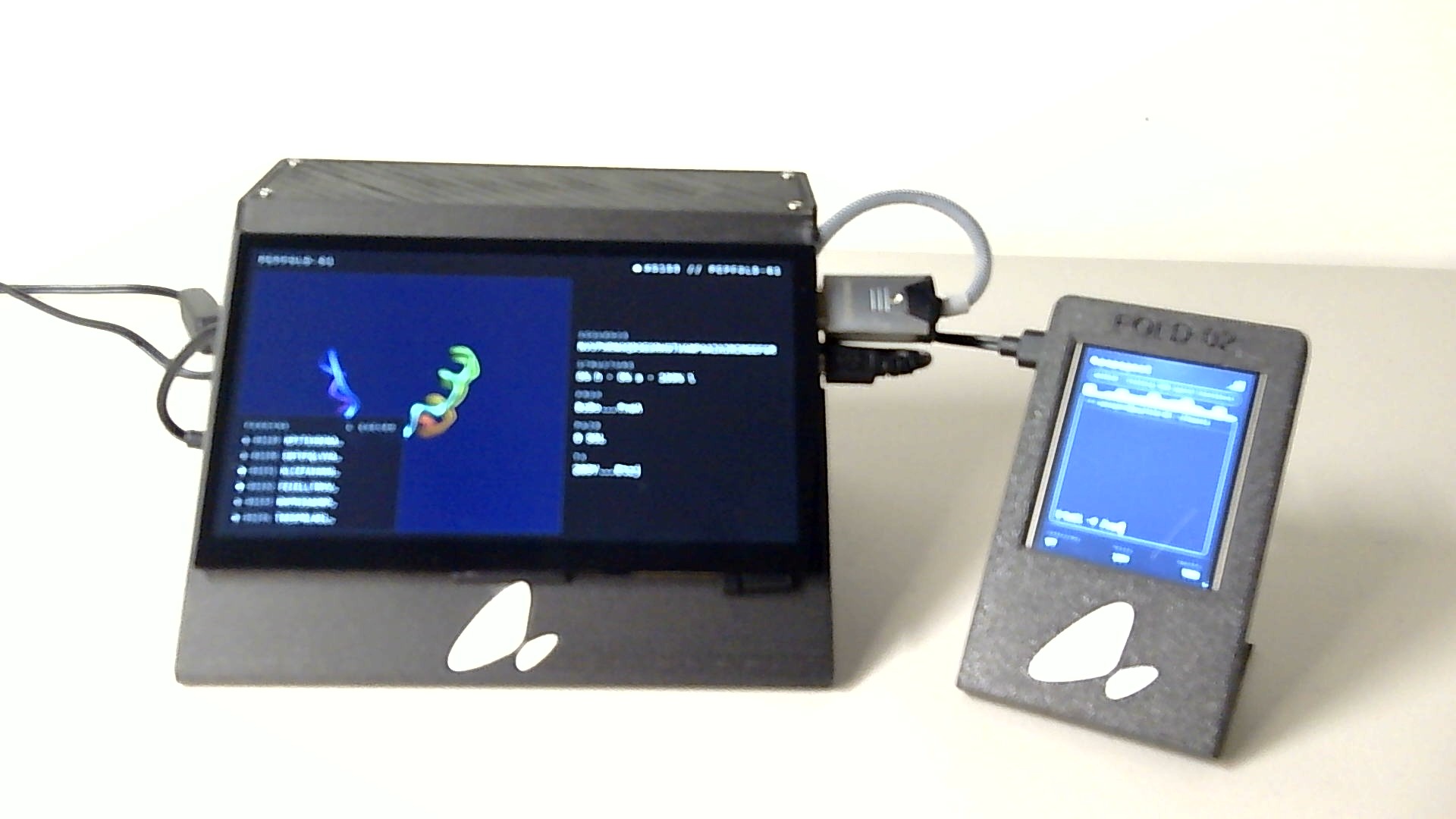
- device photo
- created
- Tue, 16 Jun 2026 07:38:32 GMT
- completed
- Tue, 16 Jun 2026 08:13:24 GMT
next experiment
what to do next
deterministic suggestions derived from this specimen's triage report. each entry cites the signal that triggered it. ordered cheapest-first.
- 1. LIABILITY REDESIGN ROUNDin silico only · 0–1d
redesign to remove the flagged motif(s) before going wet-lab: potential deamidation motif (N-G), long hydrophobic run may increase aggregation risk. minimal substitutions usually suffice (e.g. N→Q for deamidation hotspots, M→L for met oxidation).
trigger: 2 motif liability flag(s) in the sequence - 2. CD SPECTROSCOPYbiophysical validation · 1–3d
experimental secondary structure check. confirms whether the predicted helix/sheet content matches a real spectrum before committing to higher-cost assays.
trigger: fold_confidence 52% (model is uncertain) - 3. 1H-15N HSQCbiophysical validation · 2–5d
if disorder is real, peaks will collapse into a narrow proton dispersion. if the peptide is actually folded, peaks will spread out. cheapest way to distinguish IDP from misfold.
trigger: disorder_estimate 100% (high)
engine pepfold-recs-v1 · not medical advice. use as a starting point for protocol design.