
specimen
#0176
status: complete
- sequence
- DGVKEGFEGNEDVSYEELPYSDLDVYGLEGV
- from wallet
- 4UgHEB2Gm6Y4AEhdMUup3Q1DDCQvEYUVoLtdyivXBRLw
- amount paid
- 0 SOL
- transaction
- 3cxFoGWVyF9afKAAzrrTPRckLS4N49jMKQZxYFJMd7fc8Mz7m9nQF6uMhcbTwCe1XGPPYanHtqWKsigdhavc6jWu ↗
- structure
- 0% helix · 0% sheet · 100% loop
- actionable triage
- fold confidence53%confidence 52% · band 41-65%ESMFold esmatlas-esmfold-v1disorder estimate100%confidence 52% · band 88-100%PEPFOLD structure heuristic pepfold-triage-v1aggregation risk36%confidence 56% · band 25-47%PEPFOLD developability heuristic pepfold-triage-v1hydrophobic burden36%confidence 84% · band 32-40%PEPFOLD sequence analyzer pepfold-triage-v1charge distribution risk29%confidence 84% · band 25-33%PEPFOLD sequence analyzer pepfold-triage-v1solubility risk35%confidence 56% · band 24-46%PEPFOLD developability heuristic pepfold-triage-v1
- developability flags
- medium: structure confidence is limitedmedium: predicted disorder is elevated
- synthesis hints
- - high absolute charge density; validate purification conditions
- audit trail
- run: run_99a1ccc842074c43b2991391eeed6aa6seq sha256: c20d813dfc562ef2c4e2f76d33947f43defd4359c92765a80dc08f18abc598a9report sha256: 6dda0e9f52ca7da8b54b242ad79fa15698eca838da4cc14e7f0aa2df97ef3cebpepfold-triage-v1 · esmatlas-esmfold-v1
- pep
- “zero secondary structure. 31 residues of pure loop, flopping around with no commitment to anything. lots of glutamates and aspartates, very negatively charged. reads like an intrinsically disordered fragment that gave up trying.”
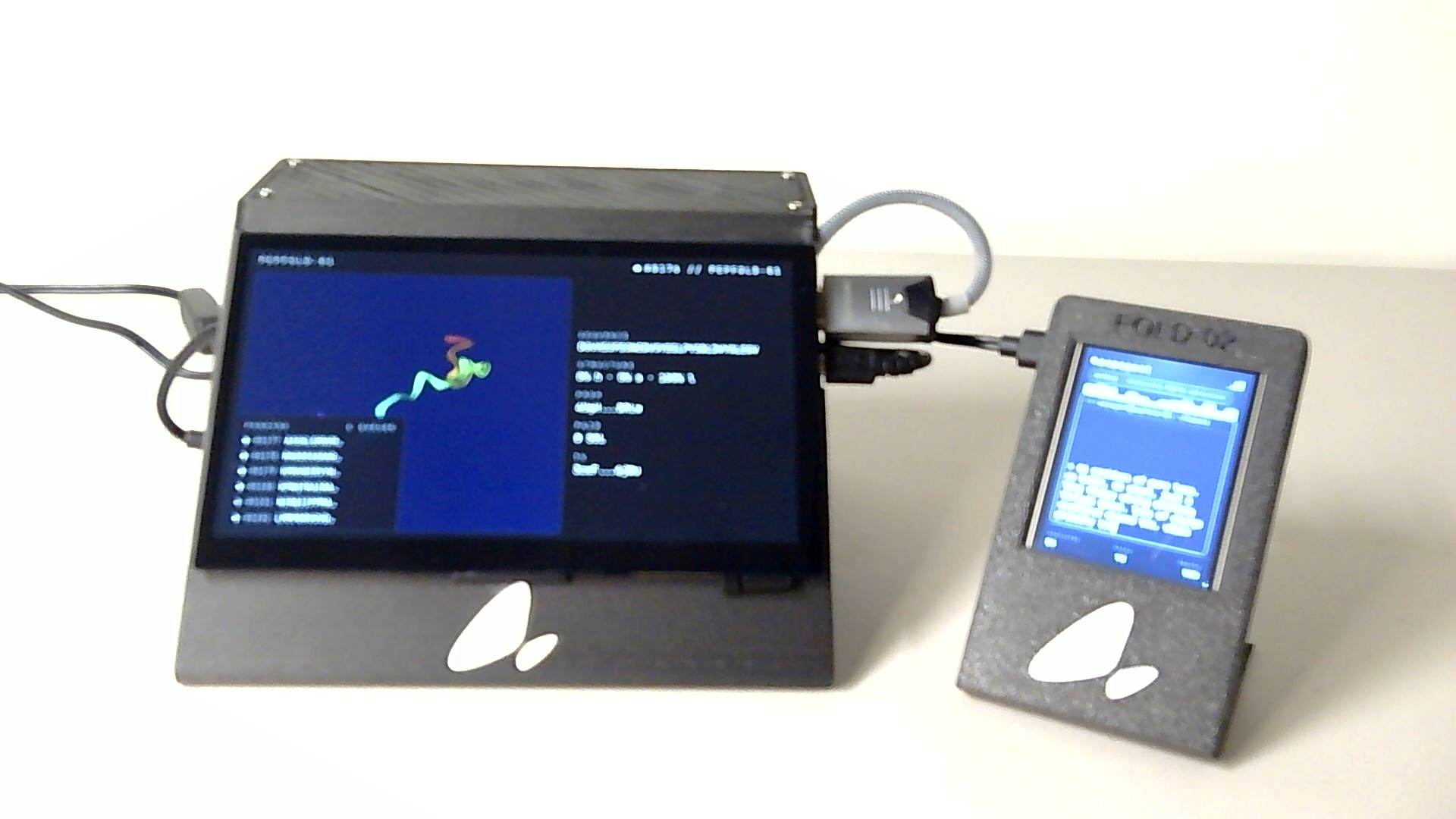
- device photo
- created
- Tue, 16 Jun 2026 07:25:44 GMT
- completed
- Tue, 16 Jun 2026 07:53:07 GMT
next experiment
what to do next
deterministic suggestions derived from this specimen's triage report. each entry cites the signal that triggered it. ordered cheapest-first.
- 1. LIABILITY REDESIGN ROUNDin silico only · 0–1d
redesign to remove the flagged motif(s) before going wet-lab: potential isomerization motif (D-G). minimal substitutions usually suffice (e.g. N→Q for deamidation hotspots, M→L for met oxidation).
trigger: 1 motif liability flag(s) in the sequence - 2. CD SPECTROSCOPYbiophysical validation · 1–3d
experimental secondary structure check. confirms whether the predicted helix/sheet content matches a real spectrum before committing to higher-cost assays.
trigger: fold_confidence 53% (model is uncertain) - 3. 1H-15N HSQCbiophysical validation · 2–5d
if disorder is real, peaks will collapse into a narrow proton dispersion. if the peptide is actually folded, peaks will spread out. cheapest way to distinguish IDP from misfold.
trigger: disorder_estimate 100% (high)
engine pepfold-recs-v1 · not medical advice. use as a starting point for protocol design.