
specimen
#0173
status: complete
- sequence
- VSFIYKARLRLEDGEKREEWHRDVVDLVPGLIPEYELSVENHLENKQEKD
- from wallet
- 62ef4jLfuT2zYFwBsTqHCHXMWkHAPiNn7dfeEn8qj37Q
- amount paid
- 0 SOL
- transaction
- 3dm3WVHWu4ezuCv2hB4GmaefX7hanUjguVNo8KCWiz8pAjM6xztkB4xz9TDPS1sQUgqy8Eab2Z4KkztvJvPPMMKh ↗
- structure
- 0% helix · 0% sheet · 100% loop
- actionable triage
- fold confidence49%confidence 52% · band 37-61%ESMFold esmatlas-esmfold-v1disorder estimate100%confidence 52% · band 88-100%PEPFOLD structure heuristic pepfold-triage-v1aggregation risk33%confidence 56% · band 22-44%PEPFOLD developability heuristic pepfold-triage-v1hydrophobic burden36%confidence 84% · band 32-40%PEPFOLD sequence analyzer pepfold-triage-v1charge distribution risk10%confidence 84% · band 6-14%PEPFOLD sequence analyzer pepfold-triage-v1solubility risk29%confidence 56% · band 18-40%PEPFOLD developability heuristic pepfold-triage-v1
- developability flags
- medium: structure confidence is limitedmedium: predicted disorder is elevated
- synthesis hints
- - sequence length >45 aa may reduce synthesis yield
- audit trail
- run: run_659197431dde4280b9f206364f63566fseq sha256: 2e3d9aa96d5b0763bbac5744fcbe8fba44e0efe33de4f48fcce96e024e91212dreport sha256: 19fafb0734670b298500f734136b557488a1a6f8d737510e032b472cebc10c60pepfold-triage-v1 · esmatlas-esmfold-v1
- pep
- “50 residues of pure loop. no helix, no sheet, just flailing. plenty of charged residues scattered throughout, which usually means it wants a binding partner to tell it who to be.”
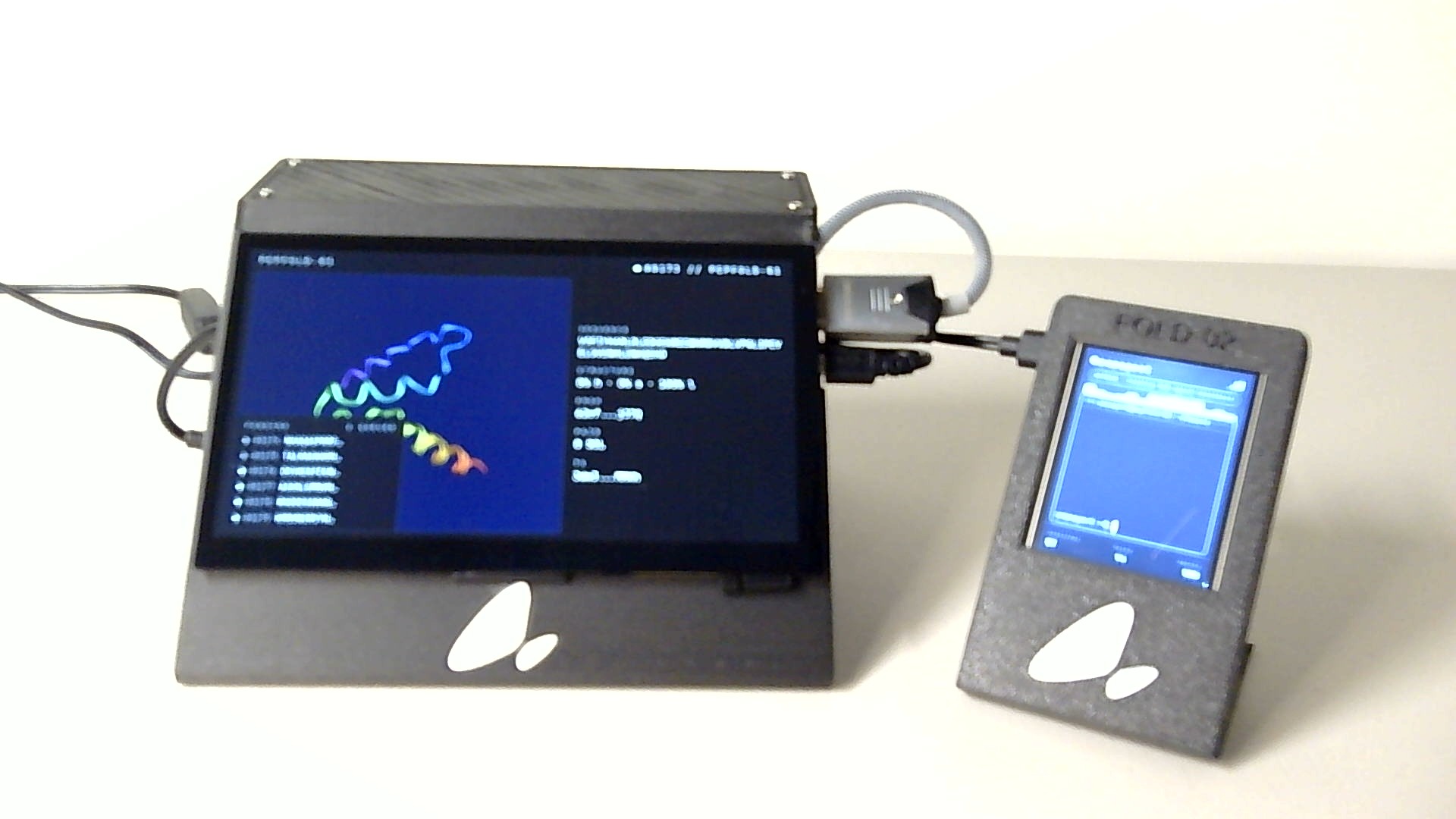
- device photo
- created
- Tue, 16 Jun 2026 07:22:31 GMT
- completed
- Tue, 16 Jun 2026 07:48:39 GMT
next experiment
what to do next
deterministic suggestions derived from this specimen's triage report. each entry cites the signal that triggered it. ordered cheapest-first.
- 1. LIABILITY REDESIGN ROUNDin silico only · 0–1d
redesign to remove the flagged motif(s) before going wet-lab: potential isomerization motif (D-G). minimal substitutions usually suffice (e.g. N→Q for deamidation hotspots, M→L for met oxidation).
trigger: 1 motif liability flag(s) in the sequence - 2. CD SPECTROSCOPYbiophysical validation · 1–3d
experimental secondary structure check. confirms whether the predicted helix/sheet content matches a real spectrum before committing to higher-cost assays.
trigger: fold_confidence 49% (model is uncertain) - 3. 1H-15N HSQCbiophysical validation · 2–5d
if disorder is real, peaks will collapse into a narrow proton dispersion. if the peptide is actually folded, peaks will spread out. cheapest way to distinguish IDP from misfold.
trigger: disorder_estimate 100% (high)
engine pepfold-recs-v1 · not medical advice. use as a starting point for protocol design.